Source Flat Outdoor Fiber Optic Cable for Communication, Sensor, Art
Explore 30 options for flat outdoor fiber optic cable suitable for communication, sensor, and art applications. Buyers can compare specifications including fiber types, armor, and certifications from verified manufacturers in China.
Key considerations
Products List




Comprehensive Sourcing Guide
Strategic Sourcing Guide for Flat Outdoor Fiber Optic Cable
Understanding the Technical Landscape of Flat Outdoor Cables
When sourcing flat outdoor fiber optic cable, buyers must first distinguish this specific form factor from the more ubiquitous round loose tube designs. The supplied product data indicates a distinct material profile where the "Material Shape" is explicitly listed as "Flat Wire," contrasting with the "Round Wire" shapes found in other cable categories. This geometric difference is not merely aesthetic; it fundamentally alters the cable's installation mechanics, particularly in environments where space is constrained or where the cable must be routed under floorboards, along walls, or through tight conduit runs.
The core construction of these cables often involves a "Single Jacket" or "Double Jacket" style, as noted in the product attributes. The sheath material is critical for outdoor durability, with "PE" (Polyethylene) being a standard choice for its resistance to moisture and UV degradation, though some listings also reference "PC" (Polycarbonate) for specific jacketing requirements. The internal architecture varies significantly; while some products utilize a "Loose Tube" construction suitable for high fiber counts like the "48 Core" models, others are designed for "Multicore" applications with lower counts, such as the "2-12 Core" range.
A crucial technical distinction lies in the fiber type itself. The market offers both single-mode and multi-mode options. The data highlights "Single-mode Fiber" types including OS2, G657A1, G657A2, and G657b3, which are optimized for long-distance transmission and are often preferred for outdoor backbone applications. Conversely, multi-mode options like Om1, Om2, Om3, Om4, and Om5 are available for shorter reach scenarios. The "Connection Structure" is frequently specified as "SC," which is a standard connector type, though buyers must verify if the cable is pre-terminated or requires field termination. The "Allowed Lateral Pressure" and "Allowed Tensile Strength" are vital performance metrics; observed ranges in the supply base vary from 100N to over 1000N for tensile strength and from 100N/100mm to over 1000N/100mm for lateral pressure, indicating that not all flat cables are suitable for direct burial or high-tension aerial installations without specific reinforcement.
Compliance and Certification Verification Protocols
In the B2B procurement of outdoor fiber optics, compliance is not optional; it is a prerequisite for market entry and operational safety. The supplied data reveals a fragmented certification landscape where different products carry different sets of approvals. Buyers must rigorously verify that the specific batch they intend to purchase holds the necessary certifications for their target region and application. Common certifications observed in the product pool include "RoHS," "CE," and "ISO." Specifically, "ISO9001" is noted as a quality management certification, while "RoHS" ensures compliance with restrictions on hazardous substances.
However, a single product listing may not carry all certifications. For instance, one entry lists "RoHS, CE, ISO," while another might only list "CE" or "RoHS, ISO." This variance necessitates a strict verification process where the buyer requests the specific certificate of conformity for the exact model number (e.g., GYTS, GYTC8A, GYXTW) being procured. Relying on a general "ISO" claim without specifying the standard (e.g., ISO 9001 vs. ISO 14001) is insufficient. Furthermore, the "Connection Structure" and "Fiber Type" must align with the certification scope; a cable certified for indoor use may not be valid for outdoor "Direct-Burial" or "Aerial Installation" applications even if it bears a CE mark.
Buyers should also be aware of the "Standard" specifications listed, such as "12 Cores" or "2-12 Core," which often correlate with specific industry standards like ITU-T G.657 for bend-insensitive fibers. When a product claims to meet a standard like "GYTS" or "GYXTW," these are model codes that imply adherence to specific Chinese or international standards for optical fiber cables. The buyer must confirm that the "prod_standard" listed matches the regulatory requirements of the destination country. For example, if the project is in the European Union, the CE mark is mandatory, and the RoHS directive must be strictly enforced. In other regions, local standards may supersede these general certifications. The presence of "Fumigated" packaging options, such as "Iron-Wooden Drum with Fumigated or Not," is another compliance point, particularly for international shipping where ISPM 15 standards for wood packaging may apply.
Cost Drivers and Pricing Structure Analysis
The pricing of flat outdoor fiber optic cables is influenced by a complex interplay of fiber count, construction complexity, and material composition. The observed price range in the market spans from $0.01 to $140 per unit, a wide disparity that reflects the diversity of product configurations. The lower end of this spectrum typically corresponds to low fiber count cables (e.g., 2-core or 4-core) with simpler "Single Jacket" construction and basic "PE" sheathing. Conversely, the higher price points are associated with high-density cables, such as the "48 Core" models, which require more complex "Loose Tube" structures, "Corrugated Steel Tape" armor, and potentially "Double Jacket" protection.
Material costs are a primary driver. The "Sheath Material" (PE vs. PC) and the "Strength Member" (Steel Wire vs. PE) significantly impact the final cost. Cables utilizing "Steel Wire" strength members for high tensile strength applications (e.g., >1000N) will generally be more expensive than those relying on "PE" strength members. Additionally, the "Armor" type, such as "Corrugated Steel Tape," adds material and manufacturing costs but is essential for "Direct-Burial" applications where rodent protection and mechanical crush resistance are required.
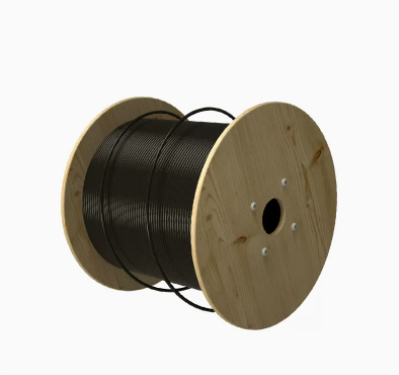
The "MOQ" (Minimum Order Quantity) is another critical cost factor. The observed MOQ range is vast, from 1 to 10,000 units. Buyers ordering small quantities may face a higher per-unit cost due to setup fees and the inability to leverage economies of scale. Conversely, large volume orders can often negotiate better pricing, potentially bringing the cost closer to the lower end of the observed range. The "prod_packing" method also influences logistics costs; "Wooden Drum" packing is standard for large reels, while "Plywood Drum and Carton" packing might be used for smaller, more delicate shipments, affecting the overall landed cost. Buyers should also consider the "Customization" availability; while "Available" customization can add value, it often incurs additional tooling or setup charges that must be factored into the total cost of ownership.
Typical Applications and Installation Scenarios
Flat outdoor fiber optic cables are uniquely suited for specific installation scenarios where the physical profile of the cable offers a distinct advantage over round cables. The primary application domain is "Communication," as indicated by the product attributes, but the data also lists "Medicine," "Sensor," "Art," and "Probe" as potential uses. For communication networks, these cables are ideal for "FTTH" (Fiber to the Home) deployments where the cable must be routed through tight spaces, such as under carpeting, along baseboards, or through existing conduit systems that cannot accommodate large round cables.
The "Applications" field explicitly mentions "Aerial Installation," "Direct-Burial," and "Duct" installation. For "Direct-Burial," the cable must possess high "Allowed Lateral Pressure" (>1000 N/100mm) and robust armor, such as "Corrugated Steel Tape," to withstand soil pressure and potential rodent attacks. The "GYTC8A" and "GYTS" models, which often feature steel armor and loose tube construction, are typically designed for these harsh environments. For "Aerial Installation," the "Allowed Tensile Strength" is paramount; cables with "Steel Wire" strength members capable of withstanding >1000N are preferred to support the cable's weight and resist wind loads.
In "Duct" installations, the flat profile can reduce friction and make pulling the cable easier compared to round cables of equivalent fiber count. The "Characteristics" listed, such as "Good Mechanical and Temperature Performance," are essential for outdoor durability, ensuring the cable can withstand extreme temperature fluctuations without cracking or losing optical performance. The "Color" options, typically "Black or Other," are often chosen for UV resistance and aesthetic blending with the environment. For specialized applications like "Sensor" or "Art," the flexibility and flat profile allow for creative routing and integration into non-traditional structures, provided the cable meets the specific mechanical requirements of the installation site.
Supplier Evaluation and Capability Assessment
Evaluating suppliers for flat outdoor fiber optic cables requires a deep dive into their manufacturing capabilities and product consistency. The data indicates that the "Brand" is often "OEM," suggesting that many suppliers operate as original equipment manufacturers or private labelers. This implies that the buyer should focus on the supplier's actual production capacity rather than brand reputation. The "prod_origin" is consistently listed as "Shenzhen, China" or simply "China," indicating a concentration of manufacturing in this region. Buyers should verify the specific factory location to ensure it aligns with their supply chain strategy and to assess the logistical implications of shipping from this hub.
Key evaluation criteria include the supplier's ability to provide "Customization." Since "Customization" is listed as "Available," suppliers should be able to tailor the "Fiber Count," "Jacket Type," and "Sheath Material" to specific project needs. However, buyers must verify the lead time implications of customization. The "prod_packing" options, such as "Wooden Drum" or "Plywood Drum and Carton," also reflect the supplier's logistics capabilities. A supplier offering "Fumigated" packaging demonstrates compliance with international shipping standards, which is crucial for export.
Furthermore, the "Certification" status must be verified on a per-shipment basis. A supplier claiming "RoHS, CE, ISO" certifications must provide valid, up-to-date documentation for the specific products being ordered. The "Product Name" and "Model" (e.g., GYXTW, GJYXCH) should be consistent across all documentation. Buyers should also assess the supplier's quality control processes, particularly regarding the "Allowed Tensile Strength" and "Allowed Lateral Pressure" claims. A reliable supplier will provide test reports or third-party verification for these mechanical properties, ensuring that the cable will perform as expected in the field.
Quality Control and Long-Term Procurement Considerations
Ensuring the long-term reliability of flat outdoor fiber optic cables requires a robust quality control (QC) strategy. The "Characteristics" of "Good Mechanical and Temperature Performance" are not just marketing claims but measurable attributes that must be validated. Buyers should insist on test results for tensile strength and lateral pressure, especially since the observed ranges vary significantly (e.g., 100N to 10000N). For critical infrastructure projects, third-party testing of the "Fiber Type" (e.g., G657A1 vs. G657b3) is essential to confirm bend-insensitivity and transmission loss specifications.
The "Construction" method, whether "Loose Tube" or another design, affects the cable's longevity. Loose tube construction is generally preferred for outdoor applications as it allows the fibers to move freely within the tube, protecting them from stress caused by temperature changes and mechanical strain. The "Strength Member" material, whether "Steel Wire" or "PE," must be consistent with the cable's intended use. For example, a cable with a "PE" strength member may not be suitable for high-tension aerial installations where a "Steel Wire" member is required.
Long-term procurement considerations also include the "prod_packing" integrity. "Wooden Drum" packing is standard for protecting the cable during transit, but the condition of the drum upon arrival must be inspected. Any damage to the drum or the cable reel can lead to fiber breakage or sheath damage. Additionally, buyers should consider the "Lead Time" implications of the "MOQ" and "Customization" requirements. High-volume orders with customization may require longer lead times, which must be factored into the project schedule. Finally, the "Color" and "Jacket Type" should be selected not just for aesthetics but for their long-term resistance to environmental degradation, ensuring the cable remains functional and visible for maintenance purposes over its lifespan.
Comparative Analysis of Cable Specifications
To facilitate decision-making, the following table summarizes the key specifications observed in the product data, highlighting the variations that buyers must navigate.
| Feature | Low-End / Basic Configuration | High-End / Robust Configuration |
|---|---|---|
| Fiber Count | 2-12 Cores | 48 Cores |
| Fiber Type | Multi-mode (Om1-Om5) or Single-mode (OS2) | Single-mode (G657A1, G657A2, G657b3) |
| Material Shape | Flat Wire | Flat Wire (with varying core density) |
| Sheath Material | PE or PC | PE (with Double Jacket options) |
| Strength Member | PE | Steel Wire |
| Armor | None or Light | Corrugated Steel Tape |
| Tensile Strength | 100N < 1000N | 1000N < 10000N |
| Lateral Pressure | 100N < 1000N/100mm | >1000N/100mm |
| Construction | Single Jacket | Loose Tube / Double Jacket |
| Packing | Plywood Drum and Carton | Wooden Drum / Iron-Wooden Drum |
| Certifications | RoHS, CE (varies) | RoHS, CE, ISO9001 |
| Applications | Indoor/FTTH, Sensor | Direct-Burial, Aerial, Duct |
This comparison underscores the importance of matching the specific cable configuration to the project requirements. A cable suitable for a simple indoor FTTH run may fail catastrophically in a direct-burial application if it lacks the necessary armor and tensile strength. Buyers must carefully review the "prod_model" and "prod_standard" to ensure the selected cable meets the mechanical and environmental demands of the installation site. By rigorously applying these criteria, procurement professionals can mitigate risk and ensure the delivery of high-quality, reliable fiber optic infrastructure.
FAQs
What certifications are available for flat outdoor fiber optic cables?
Available certifications include RoHS, CE, and ISO standards. Buyers must verify specific batch approvals as listings vary, with some products carrying ISO9001 while others may only list CE or RoHS individually for compliance verification.
Which fiber types are supported in these flat outdoor cables?
Cables support Single-mode types like OS2, G657A1, G657A2, and G657b3. Multi-mode options such as Om1, Om2, Om3, Om4, and Om5 are also available for shorter reach scenarios depending on the specific model selected.
How is the cable constructed for outdoor durability?
Construction typically features a Loose Tube design with PE or PC sheath materials. Strength members include Steel Wire or PE, and armor options like Corrugated Steel Tape protect against mechanical stress during direct burial or aerial installation.
Can the cable be customized for specific project needs?
Customization is available for various product attributes including fiber count and jacket style. Buyers should confirm lead times and potential tooling costs when requesting tailored specifications like specific core counts or unique packing requirements.
What is the typical minimum order quantity for these cables?
The observed minimum order quantity ranges from 1 to 10000 units. Smaller orders may incur higher per-unit costs, while larger volume purchases can leverage economies of scale to reduce the overall price per unit significantly.
Where are these flat outdoor fiber optic cables manufactured?
Products originate from Shenzhen, China, or generally from China. Buyers should verify the specific factory location to ensure alignment with supply chain strategies and to assess logistical implications for international shipping and delivery.